Kernel Principle Component Analysis
Summary
Kernel Principal Component Analysis (kernel PCA) extends principal component analysis (PCA) using kernel methods. KPCA allows originally linear operations of PCA to performed in a generalized euclidean space (Reproducing kernel Hilbert space).
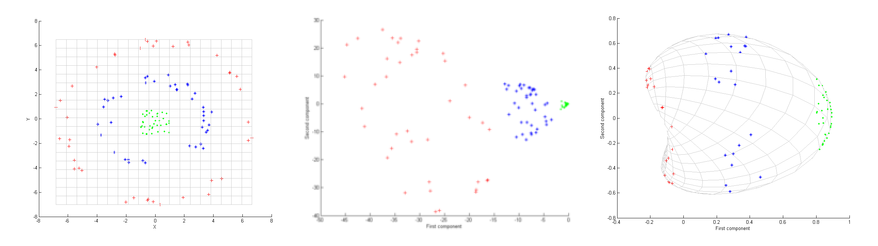
Given an appropriate kernel, it is possible to construct a hyper plane that linearly separates the classes the in feature space.
Theory
In general, kernel methods use a non-linear transformation \(\phi: \mathbb{R}^d \to \mathbb{R}^{'}\) to handle data \(\mathbb{X} = [\mathbf{x}^{(1)}, .. \mathbf{x}^{(N)}]\) in feature space.
Kernel Trick
Calculating directly in feature space is unrealistic (exaplanation). However, by defining a kernel function \(k(\mathbf{x}^{(i)}, \mathbf{x}^{(j)})=\phi(\mathbf{x}^{(i)})^{\top}, \phi(\mathbf{x}^{(j)})\) to calcualte the inner product we can perform inner product calculation in the original space. Therefore greatly reducing calculation time. This approach is named the kernel trick.
Radial Basis Function Kernel
In many kernel based classification methods, the Radial Basis Function Kernel is used. It is defined as the following:
Note
Subspaces methods such as KMSM and KCMSM universally use RBF as the kernel. RBF is also the default parameter for in support vector classifier in the scikit-learn implementation .